Types of ducks in cricket explained — Golden, Silver, Bronze, Royal, and more
From golden to royal, every type of duck dismissal in cricket is explained here with examples. See the full breakdown of what each duck means and how batters end up with one


In cricket, few things are as disappointing for a batter as walking back to the pavilion without opening the account. Such an innings is known as a duck, as it’s a common term used in the game. While all ducks are disappointing and mean the batters are being dismissed without troubling the scorers, the sport has developed some funny names to describe the dismissals and the ducks around the world in India, Pakistan, and other places.
The word ‘duck’ itself is a renowned word and has become an integral part of the game’s language and is used across the three formats: Test matches, ODIs, and T20 cricket. It can be described from an unfortunate early dismissal to all the unusual ways of leaving the crease.
Interestingly, a duck is being displayed in the same boring way. The timing of the dismissals, whether the batter faced a delivery or the stage of the innings, can be influenced by the terminology used by the players, commentators, and even the fans around the world.

Some duck-related terms are interesting in Test and first-class cricket, as a batter dismissed for zero in both innings records a pari, while it happening in both innings on the first ball is called a ‘king pair.’
From Golden to Diamond — Every type of duck in cricket and what they mean
These expressions have reflected a light and humorous side to the game’s last enjoyable outcomes. In Australia, they have shown a duck coming out with a bat and then going back with its head down on the score of zero. Some are widely recognized, while others are informal terms that have been renowned through the game’s culture and commentary.
With multiple expressions being connected with a score of zero, understanding their meanings can make the game’s scorecards and conversations even more interesting. Here is a close look at the different types of ducks in cricket and the stories behind the unusual terms:
#1 Regular Duck-

A regular duck in cricket happens when a batter gets dismissed for zero after facing more than three deliveries. It’s renowned as the common form of duck. For example, if a batter gets dismissed for zero having faced five or six deliveries, then he will be called a regular duck. It still remains a very painful experience for the batters, but at least the player would have a chance to settle.
See Also: Most ducks in ipl history: players with the most zero-run outs
In the game’s history, the former Sri Lanka captain, Sanath Jayasuriya, was dismissed for 52 international ducks, making him the player most often defamed for the unwanted record. Meanwhile, for the Indian side, Zaheer Khan is at the top with 43 ducks, followed by Ishant Sharma (40) and Virat Kohli (39).
#2 Golden Duck-
A golden duck is when a batter is dismissed on the very first ball they face. It’s sharp, and that’s why the focus always remains on the very first delivery of any batter, who always wants to be sensible and avoid any mistake on that delivery. For example, the former Indian captain, MS Dhoni, was dismissed on a golden duck on debut against Bangladesh.
In ODIs, Lasith Malinga was dismissed on most (13) golden ducks in the history, followed by Jayasuriya’s 11 and Pakistan’s Shahid Afridi’s 10 golden ducks. For the Indian side, Sachin Tendulkar has five golden ducks in the 50-over format of the game.
#3 Silver Duck-

While the first-ball duck is called a golden duck, a Silver duck happens when a batter faces two balls and gets dismissed without any runs besides his name. The scorecard reads 0 (2). The legendary former Australian captain and batter, Donald Bradman, was dismissed on a silver duck to end his career against England in 1948, which denied his average from ending on 100.
The commentators very rarely mention the Silver ducks, but it’s quite memorable in the game. For the Indian side, in Tests, Ishant was dismissed on most silver ducks (6), followed by the five occasions of Zaheer Khan and Harbhajan Singh.
#4 Bronze Duck-

The Bronze duck appears when the batter faces three balls and fails to score a run without being dismissed. The scorecard of the player reads 0 (3). The former wicket-keeper of the Australian side, Rod Marsh, recorded the bronze duck early in his career during an ODI at Edgbaston against England. It’s also a rare term being used in cricket.
See Also: List of batters with most consecutive ducks in T20Is history ft Abhishek Sharma
Bronze ducks put pressure on the batters. They play the first ball and miss the chance to open their account. This is followed by the same situation on the second delivery, where they could not score a run, before they get dismissed for a duck on the third ball.
#5 Diamond Duck-

Most readers, certainly, haven’t heard about a diamond duck. Many have been waiting for the answer to what a diamond duck is in the game, which is one of the rarest occurrences. A diamond is a very attractive thing in life, but it’s not the same in the game of cricket.
A diamond duck, which is very rare, happens when a batter is dismissed without facing a legal ball. The scenarios for this dismissal are being dismissed on run-out at the non-striker’s end. A player being dismissed by stumping off a wide delivery, or being late to reach the crease before a ball is bowled, like Angelo Mathews during the ODI World Cup 2023 in Delhi against Bangladesh, gets the diamond duck.
#6 Titanium Duck-
A Titanium duck is also a rare case and another version of the diamond duck, but it applies only to the opening batters. The opener is out without facing a delivery. It’s superbly rare, as fewer than 20 were recorded in ODIs, and fewer than 10 dismissals were recorded in Test matches.
The openers have the responsibility to provide the team with a good start, which the middle order can build upon. But they failed terribly in that aspect. For example, Ramiz Raja was dismissed for a titanium duck in 1987 during a game against the England side.
#7 Royal Duck-

The Royal duck is the term for when an opener is dismissed on the first ball of the innings. The scorecard shows 0 (1) on the very first ball of the match. For example, the former Indian opener and captain, Sunil Gavaskar, was dismissed for a royal duck against the New Zealand side in 1980.
Very recently, Saim Ayub and Azan Awais were dismissed for royal ducks during the three-match series against England in Tests. Ayub was dismissed on the very first ball of the innings at Edgbaston, while Awais was dismissed in the same fashion at Headingley, as happened against Ollie Robinson.
#8 Laughing Duck-
A laughing duck happens when the last batter of the innings is dismissed for zero. The name sounds very light, but for the batter, it's not. It’s nothing but very funny. For example, it’s the No. 11 batter getting dismissed for zero as the final wicket of the innings.
Apart from these, there is another term called the ‘Golden Goose’, which is awarded when a batter is dismissed for zero as the first wicket of a new season. It’s not official in stats but very rare.
See Also: Watch: Saim Ayub bags pair after first-ball duck vs England at Edgbaston
Meanwhile, a pair in cricket occurs when a batter scores a duck in both innings of a two-innings game, like the Test match Ayub did during the Edgbaston Test against the Joe Root-led side. On the other hand, a king pair happens when a batter gets out on the very first ball they face in both innings. Adam Gilchrist was dismissed on a king pair during a Test match against India at the Eden Gardens.
The ducks matter a lot. It may look just a failure on paper, but they are a part of the game’s history. For the batters, it becomes a test of their mental strength, while for the teams, it’s the pressure of the early wickets that can shift the momentum of the game at any time.
Types of ducks in cricket explained- FAQs
Frequently Asked Questions
In his career, Sri Lanka’s Muttiah Muralidaran was dismissed for the most ducks in international cricket. He was out for zero 59 times in 328 innings of the game.
In his career for the Indian side in international cricket, Zaheer Khan has recorded the most ducks. He was dismissed for zero runs in 44 innings out of 232 innings.
In international cricket, Sri Lanka’s Muttiah Muralidaran was dismissed on 14 golden ducks, followed by Rangana Herath’s 11 golden ducks, and 10 such occasions from Stuart Broad and Courtney Walsh.
In cricket, some of the notable players to be dismissed on King Pairs are Ajit Agarkar against Australia in 1999, Virender Sehwag against England in 2011, James Anderson against India in Vizag, Sam Curran against India at Lord’s in 2021, and Adam Gilchrist against India in Kolkata in 2001.
About the Author

Massive cricket lover and follower of world cricket since mid 2000s. Like to frame the game through stats and numbers. Bit old-school cricket lover, who always get encouraged by Test cricket. Questions few complex rules which baffle the new viewers of the game. Have been working as a cricket writer for more than 5 years.
POLL
Watch Now
 Cricket News1 min
Mohsin Naqvi congratulates Shadab Khan and Haris Rauf after Pakistan’s miraculous 1-wicket win vs England
 Cricket News1 min
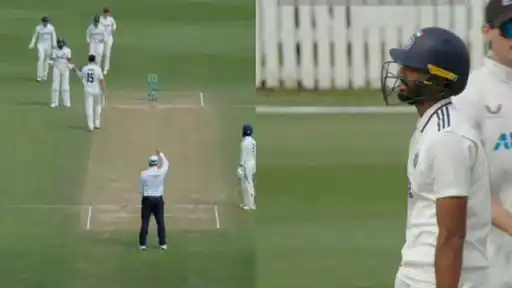
Devdutt Padikkal’s controversial dismissal on 199 in NZ-A vs IND-A 1st unofficial Test
 Cricket News1 min
Virat Kohli and Anushka Sharma attend Krishna Das Kirtan in Mumbai ahead of India vs New Zealand ODI series
Web Stories

India vs New Zealand T20 World Cup 2026 Final
Sanju Samson’s 89 vs England Powers India in T20 World Cup 2026 Semifinal

Biggest Opening Partnerships in T20 World Cup Knockouts

India vs England T20 World Cup Semifinal History
New Zealand Knock Out Sri Lanka – Super 8 Match Highlights & Key Moments